Toho vs Legendary: Two Godzillas, Compared
Toho reinvents Godzilla across separate films; Legendary develops one continuing MonsterVerse Titan. Here is how their design, scale and purpose differ.
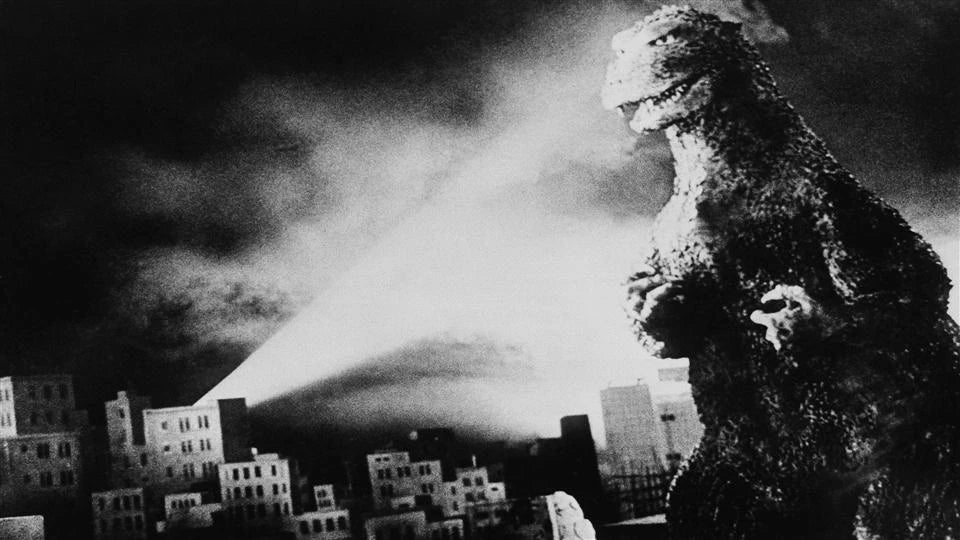
Toho and Legendary do not present one fixed pair of Godzillas. Toho repeatedly reinvents the character for different Japanese films, while Legendary maintains a continuing MonsterVerse version. The clearest comparison is therefore creative purpose: Toho's Godzilla changes with each production; Legendary's is a recurring Titan with an accumulating biography.
Is one Godzilla the original and the other a remake?
Toho created Godzilla in 1954 and has produced most of the character's films. Legendary licensed the property for the American film that opened in 2014 and built the MonsterVerse around that incarnation. Calling Legendary's version unofficial would be wrong, but calling it the same character in the same continuity would also be wrong.
Toho itself contains several continuities. The 1954 film, the Showa sequels, the Heisei run, most Millennium entries, Shin Godzilla and the Minus One story do not all describe one life. Any comparison that says Toho Godzilla always behaves one way will encounter an exception.
Why does Legendary's Godzilla look so heavy?
The 2014 design emphasises mass: a broad torso, thick legs, small feet relative to the body and dorsal plates that read as ancient natural armour. Its movement communicates weight through pauses and resistance. Later MonsterVerse films allow faster combat, but the body still has to feel capable of occupying a skyscraper-sized frame.
Toho designs have ranged from the uneven, scarred 1954 suit to the compact heroic faces of the 1960s, the muscular Heisei silhouette, the sharp Millennium spines, Shin's damaged anatomy and Minus One's aggressive digital form. The diversity is the point. Toho's visual identity is a library rather than one model sheet.
Which version is larger?
Legendary's Godzilla is generally presented at a modern megacity scale and grows across the MonsterVerse. Many classic Toho versions are smaller, beginning with the 50-metre 1954 Godzilla, while the later Heisei form reaches 100 metres. Godzilla Earth from the animated trilogy is far larger than either normal live-action comparison.
Height figures are useful reference, not proof of who would win. Films stage mass, speed and damage according to their own dramatic rules. Cross-continuity battle results are fan speculation unless a licensed story actually stages the encounter.
How does their atomic breath differ?
Classic Toho films often use a blue beam, although colour, charge pattern and strength vary. Shin's attack develops from smoke and flame into a narrow purple beam, while Minus One turns the dorsal charge and blast into a destructive event with severe recoil and aftermath.
Legendary uses illuminated dorsal plates and a blue atomic breath as recurring visual language. Godzilla x Kong: The New Empire adds an evolved pink energy state. These changes are part of that version's continuing power progression, not a replacement of every earlier Toho rule.
Is Toho's Godzilla a villain while Legendary's is a hero?
No. The 1954 Godzilla is a disaster and victim of nuclear violence. Later Showa films move the monster toward defender. The Heisei Godzilla can be destructive, territorial and occasionally protective. GMK makes Godzilla explicitly malevolent, while Minus One again treats its presence as a national catastrophe.
Legendary's Godzilla is often described as an antihero or balancing force. It protects no individual human out of friendship; it asserts an order among Titans and destroys cities while doing so. The films increasingly place it on the audience's side, particularly when another creature threatens the world, but that is not conventional human morality.
Why does the human scale feel different?
Toho's most serious entries often tie one Godzilla attack to a specific social wound. The original addresses nuclear trauma; Shin studies state response; Minus One follows damaged people rebuilding after war. Other Toho films are lighter adventures, so this is a tendency rather than a universal rule.
The MonsterVerse spreads its story across a global mythology. Monarch, Hollow Earth, Titan ecology and recurring characters connect set pieces over several productions. Individual grief remains present, but the franchise engine is exploration and escalation.
Which version suits collectors better?
Neither is inherently better. A Toho shelf offers radical changes of silhouette and decades of opponents. A MonsterVerse shelf offers a more consistent modern cast: Godzilla, Kong, Ghidorah, Mothra, Rodan, Mechagodzilla and newer Titans. Mixing them can work, but nominal scale labels do not guarantee matching heights.
The useful conclusion is not that one studio understands Godzilla and the other does not. Toho uses reinvention to keep the symbol responsive; Legendary uses continuity to turn a Titan into a long-form protagonist. Preference between them is taste, not a factual ranking.
How do the effects traditions shape the comparison?
Classic Toho Godzilla is inseparable from suit performance, miniature photography, optical effects and carefully staged destruction. Modern Toho films have moved through extensive digital work, but Shin and the Minus films still quote the posture, framing and physical clarity established by those older methods.
Legendary builds its Titans primarily through contemporary visual-effects pipelines and performance reference, integrating them into photographed cities, oceans and digital environments. This allows camera movement and battles that would be impractical on miniature stages.
Neither method automatically produces weight. Weight comes from timing, sound, scale references and how the environment responds. Fans who prefer one tradition are expressing an aesthetic judgement, not proving that practical or digital imagery is inherently more truthful.
The strongest films use their chosen method consistently.
What does the distinction mean if you collect?
Buy by studio continuity, screen year and exact edition. Tamashii's 2026 schedule, for example, lists separate Movie Graphic Plus S.H. MonsterArts figures for Godzilla 1954 and Legendary's Godzilla 2014. Both use the Godzilla name and both were listed for release in 2026, but they reproduce different bodies, films and licensing branches.
A shelf can still mix them deliberately. Use the year printed in the official product title to avoid treating “classic Godzilla” or “MonsterVerse Godzilla” as a sufficient listing identity. When building a battle scene, compare centimetres and silhouette; neither the shared brand nor the fictional height guarantees that two products were engineered as scale partners.
What is confirmed, and what is fan opinion?
Toho's 1954 creation, Legendary's licensed 2014 continuity, the films' stated heights and each version's on-screen abilities are documented. The pink evolved state in the 2024 film is also an event within the MonsterVerse, not a redesign retroactively applied to Toho films.
“Stronger,” “more faithful” and “the real Godzilla” are fan judgements. Cross-continuity winners, implied power levels and claims that a sculpt is definitive remain opinion unless an official story or product specification answers the exact comparison.
Related reading
What Makes a Kaiju a Kaiju? · Best Ultraman Series to Start With · What Is the Metal Hero Series?
Written by Kakebo · Published August 23, 2026.